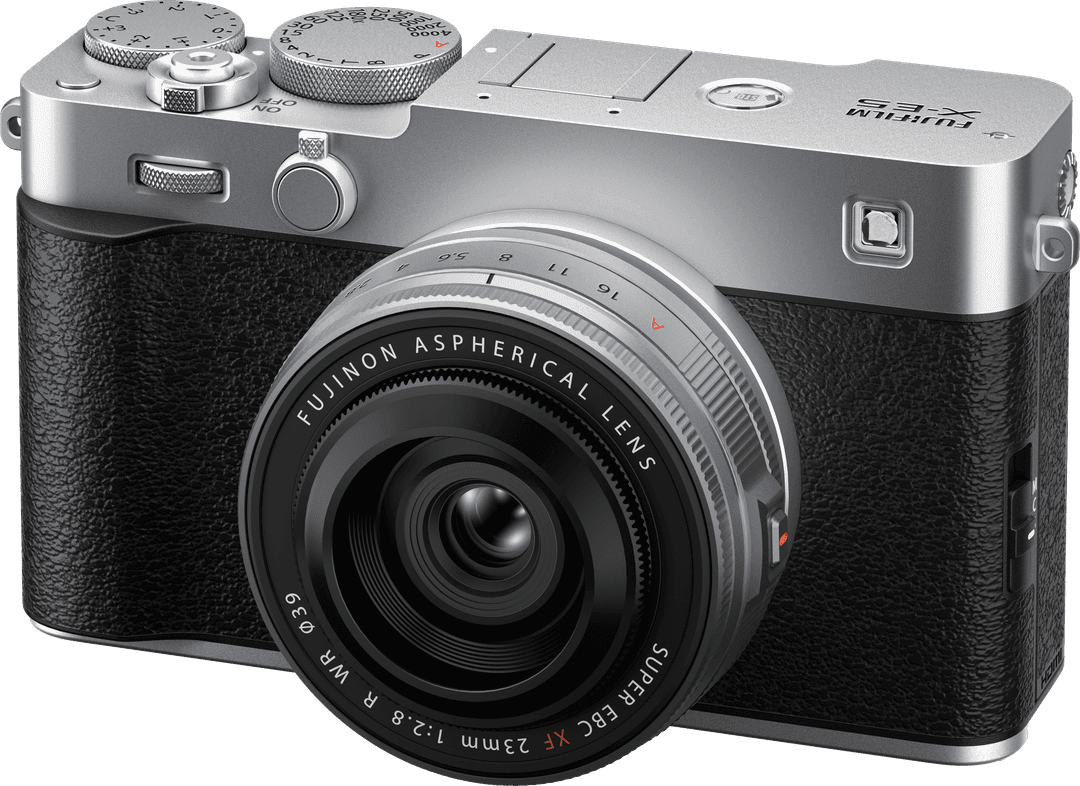
Fujifilm
X-E5
2025
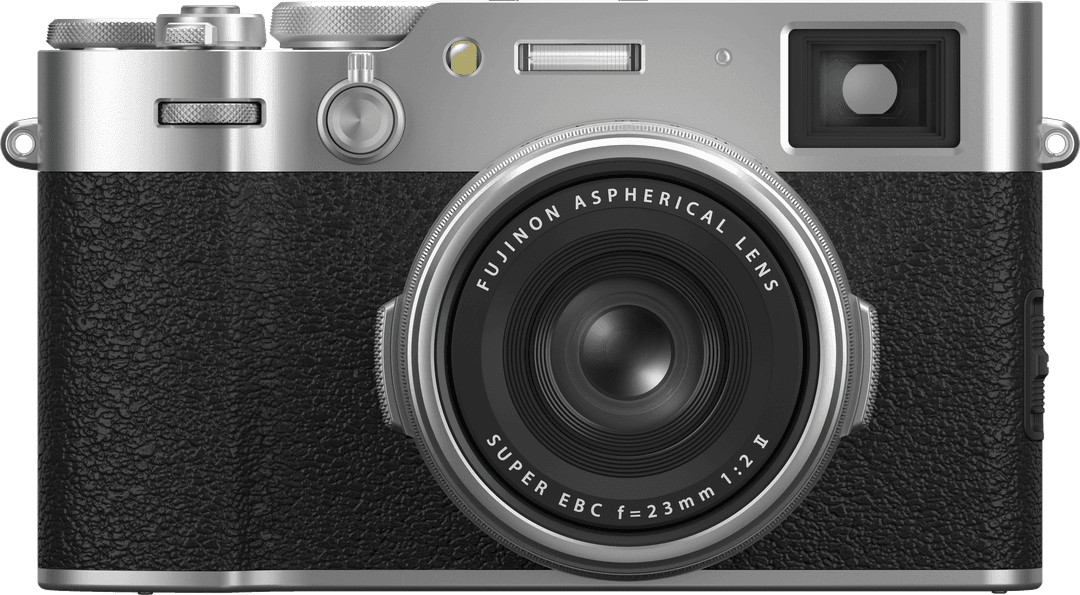
Fujifilm
X100VI
2024
Fujifilm X-E5 vs X100VI: Which to choose between versatility and iconic compactness?
Visual summary
— Reads in 5 seconds
Fujifilm
X-E5
Fujifilm
X100VI
The arbitration in brief
Choose the X-E5 for unlimited video and maximum stabilisation, the X100VI if the fixed lens and hybrid viewfinder define your practice.
These two cameras share the same X-Trans CMOS 5 HR sensor with 40.2 megapixels, the same X-Processor 5, and the same native ISO range of 125 to 12,800. On paper, the duel seems close. In practice, they cater to very different photographers.
The X100VI was released in 2024. It's a compact with a fixed 23mm f/2 lens, designed for street, travel, and environmental portraiture. Its hybrid OVF/EVF viewfinder is a signature of the X100 series. Its launch price was €1,799, €250 more than the X-E5 in Europe.
The X-E5 was released in 2025. It's a mirrorless camera with an X-mount, positioned in the lineage of Fujifilm's X-E rangefinders. It targets hybrid photographers who want a compact body without sacrificing optical versatility or video capabilities. Its launch price is €1,549.
This comparison arbitrates a concrete choice: accept the fixed lens of the X100VI to benefit from its exceptional buffer and superior viewfinder, or opt for the flexibility of the X-E5 with its more powerful IBIS, unlimited video recording, and access to the entire X-mount lens lineup. Both cameras target portrait, travel, and street photography. Video usage and challenging lighting conditions make the difference.
Standout strengths
— Where each camera shines
Fujifilm
X-E5
Top advantages
- 7 stopsIBIS rating+17 % vs Fujifilm X100VI
- -7 EVAF low light (EV)+2 vs Fujifilm X100VI
- OuiUnlimited recordingAbsent sur Fujifilm X100VI
- OuiXLR inputAbsent sur Fujifilm X100VI
Fujifilm
X100VI
Top advantages
- 11 fpsMechanical burst+38 % vs Fujifilm X-E5
- 84RAW buffer4,9× vs Fujifilm X-E5
- 3.69 M dotsViewfinder resolution1,6× vs Fujifilm X-E5
- 1.62 M dotsScreen resolution1,6× vs Fujifilm X-E5
Detailed spec-by-spec
— Round by round, the eight categories
Sensor
Autofocus
Speed & burst
Video
Stabilisation
Build
Ergonomics & screen
Connectivity & battery
Detailed analysis analysis
— Strengths, trade-offs and ideal user
Fujifilm X-E5: what it does well, what it concedes
The X-E5 features an IBIS that compensates for 7 stops, compared to 6 stops on the X100VI. An extra stop of stabilisation is the equivalent of being able to lower your shutter speed by one step when shooting handheld. In landscape or travel photography, this extra margin counts during golden hour lighting. This is the most immediate advantage of the X-E5 for non-sports uses.
Its AF in low light is certified down to -7 EV, compared to -5 EV for the X100VI. Two stops of difference in AF sensitivity is the difference between locking focus in a non-lit alleyway and missing the scene. For night street or travel in dark environments, this difference is measurable and significant.
The key strengths of the X-E5 in summary:
- 7 stops of IBIS, one stop more than the X100VI.
- Low light AF down to -7 EV, two stops of extra margin.
- Unlimited video recording in H.265 10-bit with F-Log2.
- ProRes RAW and Blackmagic RAW output via HDMI for professional workflows.
- Weight of 445g compared to 521g, 76g lighter.
The compromises are real. The X-E5's RAW buffer tops out at 17 images, compared to 84 on the X100VI. In mechanical burst mode, it's limited to 8 fps compared to 11 fps. For any use requiring long sequences, the X-E5 is clearly lacking. Its screen displays 1.04 million points and its viewfinder 2.36 million points, both lower than the X100VI. The lack of weather sealing on both cameras is a deal-breaker for extreme use conditions. The X-E5's SD UHS-II card is a subtle but real advantage over time, especially for high video bitrates.
For whom
The X-E5 is suitable for the travelling photographer who wants a compact body capable of accommodating multiple focal lengths, from wide-angle to portrait. It's also suitable for hybrid content creators who record video in varied conditions and don't want to deal with a recording time limit. Its 7 stops of IBIS and -7 EV AF make it a solid tool for night street photography and travel in challenging lighting. It's also the logical choice for anyone who already owns an X-mount lens collection.
Fujifilm X100VI: what it does well, what it concedes
The X100VI features a RAW buffer of 84 images, compared to 17 on the X-E5. This is the most striking difference in this comparison. In practice, 84 images in burst mode before buffer saturation means you can shoot sequences without waiting for the buffer to clear. For reportage, weddings, or any situation where decisive moments come in quick succession, this advantage is structural.
Its mechanical burst mode reaches 11 fps, compared to 8 fps for the X-E5. In electronic mode, both cameras are equal at 20 fps. However, mechanical mode is preferable for avoiding rolling shutter on fast-moving subjects. Combined with its 84-image buffer, the X100VI is clearly superior for capturing action.
The key strengths of the X100VI in summary:
- RAW buffer of 84 images, 4.9 times that of the X-E5.
- Mechanical burst mode at 11 fps, compared to 8 fps.
- Hybrid OVF/EVF viewfinder with 3.69 million points and 0.66x magnification.
- Screen with 1.62 million points, compared to 1.04 million on the X-E5.
- Measured dynamic range of 10.4 EV, very close to the X-E5's 10.6 EV.
The compromises are equally clear. The fixed 23mm f/2 lens is an absolute constraint: no possibility of changing focal length without an adapter or optical conversion. Video recording is limited to 30 minutes per clip. The SD UHS-I card caps write speeds, which can create bottlenecks in high-resolution video. The IBIS is limited to 6 stops and low light AF only reaches -5 EV. Its launch price in Europe was €1,799, €250 more than the X-E5, for a fixed-lens camera.
For whom
The X100VI is suitable for street or travel photographers who have deliberately chosen the fixed 23mm lens. It's also suitable for those who photograph punctual events where buffer and mechanical burst speed matter more than video recording time. The hybrid OVF viewfinder is a viewing experience that the X-E5 cannot replicate. It's a camera for photographers first, videographers second.
Our verdict
Which one to buy, and why
The X-E5 and X100VI share the same sensor DNA. The arbitration lies on three concrete axes: optical flexibility, burst capacity, and video ambitions.
On video, the X-E5 wins without discussion. Its unlimited recording, ProRes RAW output via HDMI, and 7-stop IBIS form a combination that the X100VI cannot match. The X100VI's 30-minute limit is a deal-breaker for any long-form shooting.
On photography, the X100VI takes the lead on one specific point:
- Buffer of 84 images compared to 17, a 1 to 4.9 ratio.
- Mechanical burst mode at 11 fps compared to 8 fps.
- Viewfinder with 3.69 million points compared to 2.36 million.
- Screen with 1.62 million points compared to 1.04 million.
These four advantages are consistent with a reportage or event-based usage. However, they do not compensate for the lack of optical flexibility for a photographer who changes focal length depending on the situation.
On price-performance, the X-E5 is €250 cheaper in Europe at launch, for an interchangeable-lens camera. The X100VI can now be found on the second-hand market at varying prices depending on condition, which may rebalance the scales for a patient buyer.
The verdict is clear. Choose the X-E5 if you're a hybrid photographer, occasional videographer, or traveller with an X-mount lens collection. Its superior IBIS, more sensitive low light AF, and unlimited recording make it the most versatile tool of the two. Choose the X100VI only if the fixed 23mm lens corresponds to your vision and if the 84-image buffer meets a real need for sustained burst shooting. The fixed lens is not a compromise: it's a choice of practice. If you haven't made that choice yet, the X-E5 is the default answer.
Frequently asked questions
Before you buy, the questions we get
Which one to choose for wedding photography?
The X100VI has the advantage here. Its 84-image RAW buffer allows you to shoot sequences during key moments, such as the entrance of the couple, the first look, the bouquet toss, without waiting for the buffer to clear. Its mechanical burst mode at 11 fps is also superior. However, the fixed 23mm lens imposes a constant moving constraint. If you're working solo with a single camera, the X-E5's optical versatility may compensate for the smaller buffer. For a second camera dedicated to sequences, the X100VI is more suitable.
Does the **€250** difference in favour of the X-E5 justify itself?
The X-E5 is €250 cheaper in Europe at launch and offers an interchangeable-lens camera. The X100VI is more expensive and comes with a fixed lens. The price difference is only justified if the X100VI's fixed 23mm f/2 lens exactly matches your practice and if the 84-image buffer meets a real need. For general use, the X-E5 offers more value for money. The X100VI has been available on the second-hand market since its 2024 release, which may reduce the price difference for a patient buyer.
Can the X-E5 replace the X100VI for street photography?
Yes, provided you accept a slightly bulkier body with a mounted lens. The X-E5 weighs 445g compared to 521g for the X100VI, but the X100VI includes its lens in that weight. With a 23mm f/2 XF lens mounted on the X-E5, the combination exceeds the weight of the X100VI. However, the X-E5's -7 EV AF is more effective in low-light conditions than the X100VI's -5 EV. For night street photography, the X-E5 is objectively more comfortable.
Which camera is best suited for professional video?
The X-E5, without hesitation. It records unlimited footage, where the X100VI tops out at 30 minutes per clip. It offers ProRes RAW and Blackmagic RAW output via HDMI, which is absent on the X100VI. Its 7-stop IBIS stabilises handheld shots better. The X-E5's SD UHS-II card handles high bitrates better than the X100VI's SD UHS-I card. For any long-form shooting, such as documentaries, interviews, or extended content, the X-E5 is the only reasonable choice of the two.
Is the X100VI's hybrid viewfinder worth the difference?
The X100VI's hybrid OVF/EVF viewfinder is a viewing experience that the X-E5 cannot replicate. In OVF mode, you see the scene in real-time without lag or battery consumption. Its resolution in EVF mode is 3.69 million points compared to 2.36 million on the X-E5, with a magnification of 0.66x compared to 0.62x. For photographers who attach great importance to optical viewing, this is a strong argument. For photographers indifferent to the type of viewfinder, this advantage alone does not justify the €250 price difference.